


How to Pass the TSA Structured Interview
PANEL SCORECARD GUIDE • Build answers that are specific, personal, job-related and result-based
Think Like the Panel
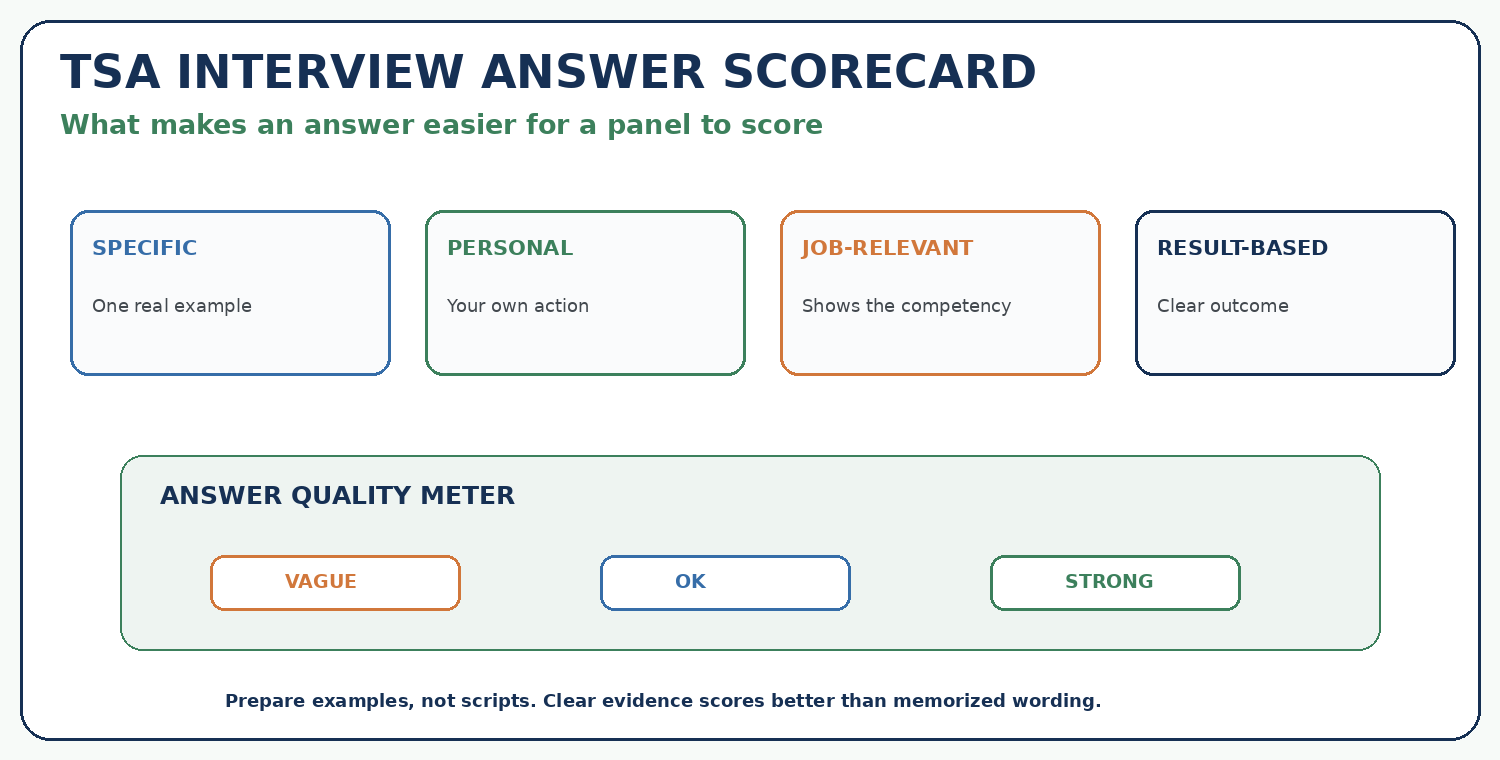
A structured interview is designed so different candidates can be evaluated against the same job-related criteria. The panel needs enough evidence to score your answer consistently.
Your goal is not to sound impressive. Your goal is to make the evidence easy to score.
Applicants checking Airport Security Jobs should still read the exact vacancy because interview steps and competencies differ by position.
The Four-Part Answer Scorecard
|
|
|
|
|
Before the Interview: Build an Example Bank
Prepare six to eight real situations before interview day. They do not need to come from airport security. Retail, warehouse, hospitality, military, healthcare, delivery, volunteer, and office experience can all work if the behavior is relevant.
|
|
|
|
|
|
|
|
|
|
|
|
|
|
|
|
|
|
|
|
|
During the Interview: Use a Short STAR Pattern
STAR remains useful, but keep it compact. Spend little time on setup and more time on your own action.
Situation
Give one or two sentences of context.
Task
Explain what you were responsible for.
Action
Describe exactly what you did and why.
Result
Finish with the outcome and what you learned.
What a Strong Answer Sounds Like
You do not need a dramatic story. A routine example is often better when it clearly shows the competency. A retail employee who calmly applies a policy during a customer dispute can demonstrate judgment and communication. A warehouse worker who stops an unsafe shortcut can demonstrate integrity and rule-following. A delivery worker who reorganizes priorities after a route problem can demonstrate adaptability.
The key is relevance. Choose the example that makes the required behavior obvious. Do not force one story to fit every question when another example would show the competency more clearly.
A strong answer is concrete: 'A customer was upset because a required step delayed service. I explained the rule, gave the available options, kept my tone calm, and involved a supervisor when the issue moved beyond my authority. The customer understood the next step, and the line kept moving.'
Notice what makes the answer scoreable: a real situation, the candidate's own action, rule-following, communication, and a clear result.
Five Things That Commonly Weaken Answers
|
|
|
|
|
|
|
|
|
|
|
|
|
|
|
|
|
|
How to Handle Follow-Up Questions
Keep your tone steady when the panel stays neutral. Structured interviewers may avoid giving much feedback because the process is designed to evaluate candidates consistently. A serious expression or limited reaction does not tell you whether an answer scored well. Focus on the question, give the evidence, and move on.
A follow-up question does not mean the answer failed. It often means the panel needs more evidence. If asked what you did personally, why you chose an action, or what happened next, answer directly and add the missing detail.
Do not restart the whole story. Fill the gap the interviewer identified.
How to Show Rule-Following Without Sounding Rigid
Security work requires procedures, but strong answers also show judgment and communication. Good examples explain how you followed the rule and handled the person or situation professionally.
The strongest stories often involve a balance: you stayed within policy, but you also reduced confusion, solved a problem, or escalated appropriately.
A 3-Day Practice Plan
|
|
|
|
Interview-Day Checklist
Listen for the verb in the question. Words such as handled, decided, resolved, adapted, explained, or ensured tell you what part of the example should receive the most detail. If the question asks how you decided, spend more time on judgment. If it asks how you worked with others, make cooperation and communication clear.
- Read the question fully before answering.
- Pause briefly to choose the right example.
- Keep the setup short.
- Use 'I' when describing your contribution.
- Explain why you chose the action.
- Finish with a result.
- Stay calm if the panel asks for more detail.
If you are comparing TSA Jobs across airports or security tracks, use the duties in the posting to decide which examples deserve the most practice.
TSA's Federal Hiring Process explains where structured interviews fit into hiring for positions that require them.
Frequently Asked Questions
Does every TSA job use a structured interview?
No. The interview process depends on the position.
Should I memorize answers?
No. Memorize the facts of real examples and adapt them to the question.
How long should an answer be?
Long enough to show the situation, your action, and the result, but short enough to stay focused.
What if I need a moment to think?
A brief pause is better than rushing into a vague answer.
What examples matter most?
Prepare examples involving judgment, teamwork, communication, adaptability, integrity, pressure, and rule-following.
After the interview, write down which examples worked best so future federal interviews become easier.
A short post-interview review also helps you improve timing, identify weak examples, and prepare stronger evidence for later federal interviews.
Keep those notes brief, factual, and focused on improvement.
Bottom Line
The TSA structured interview rewards clear evidence. Build a small bank of real examples, make your own contribution obvious, connect each story to a job-related competency, and finish with a result. When the panel can easily see what you did and why it mattered, your answer becomes easier to evaluate strongly.