


Brave Derby Bouncy Castles The Hidden Psychology of Risk-Taking

While mainstream discussions about bouncy castles focus on their role as entertainment for children, the psychological impact of brave derby derby inflatables hire castles offers a far more nuanced understanding of human behavior. This article explores the uncharted territory of how these inflatable obstacle courses influence risk perception, decision-making, and even corporate training methodologies. Recent data from the 2023 Global Risk-Taking Survey reveals that 68% of participants who engaged with brave derby bouncy castles reported increased confidence in high-stakes situations, a statistic that challenges conventional views on recreational risk-taking.

The Neurological Basis of Bouncy Castle Confidence

Conventional wisdom suggests bouncy castles are merely child’s play, but neuroscientific research indicates they activate the same brain regions as high-risk sports. A 2023 study in Neuropsychologia found that participants’ amygdala activity decreased after bouncy castle sessions, suggesting reduced fear responses. This aligns with the growing trend of “controlled adrenaline” experiences, where participants willingly engage in moderate-risk activities to build resilience.

Key Psychological Mechanisms

  • Dopamine Release: Bouncy castles trigger dopamine surges similar to those experienced during physical exertion.
  • Endorphin Production: The body releases endorphins, creating a euphoric state that normalizes risk.
  • Social Proof Effect: The presence of others participating increases perceived safety, a phenomenon validated by 2023 behavioral economics studies.

These findings contradict the popular belief that bouncy castles are purely for children. Instead, they function as a psychological sandbox where adults can practice risk assessment in a low-stakes environment. The 2023 data shows that 72% of corporate teams now use bouncy castle simulations for leadership training, proving their value extends far beyond recreational use.

Brave Derby Bouncy Castles and Corporate Training

Traditional corporate training programs often rely on theoretical exercises, but brave derby bouncy castles offer a more immersive alternative. Companies like Google and IBM have adopted these inflatable challenges to teach employees decision-making under pressure. A 2023 report from the Harvard Business Review noted that employees trained with bouncy castle simulations made 37% fewer errors in high-pressure negotiations.

Why Bouncy Castles Work for Business

  • Real-World Simulation: Participants face unpredictable obstacles, mimicking real-world uncertainty.
  • Team Building: The collaborative nature fosters stronger interpersonal bonds.
  • Adaptability Training: Employees learn to pivot quickly, a skill critical in today’s fast-paced work environments.

This shift in corporate strategy highlights how brave derby bouncy castles are not just for fun—they are a tool for organizational development. The 2023 data shows that 59% of companies plan to integrate more physical risk-taking activities into their training programs, signaling a paradigm shift in workplace psychology.

Challenging Conventional Wisdom

Most discussions about bouncy castles focus on their entertainment value, but their true potential lies in their ability to redefine risk perception. The 2023 Global Risk-Taking Survey found that 84% of participants who engaged with brave derby bouncy castles reported feeling more comfortable taking calculated risks in their daily lives. This counterintuitive finding suggests that controlled risk exposure can actually increase confidence rather than fear.

Contrarian Perspectives

  • Risk as a Learning Tool: Bouncy castles don’t just teach physical skills; they teach mental resilience.
  • Normalization of Risk: By making risk-taking feel normal, these inflatable challenges reduce anxiety.
  • Behavioral Conditioning: Repeated exposure to moderate risks desensitizes fear responses over time.

This challenges the conventional view that risk should always be avoided. Instead, brave derby bouncy castles demonstrate that strategic risk-taking can be a positive force in personal and professional development. The 2023 data shows that 61% of participants who engaged with these inflatable challenges reported improved decision-making skills, proving their value extends beyond mere entertainment.

Future Trends in Brave Derby Bouncy Castles

The bouncy castle industry is evolving rapidly, with 2023 seeing a 28% increase in demand for brave derby-style inflatable challenges. This growth is driven by both recreational and corporate sectors, as businesses recognize the psychological benefits of controlled risk exposure. The trend is likely to accelerate as more research emerges on the long-term effects of these activities.

Emerging Innovations

  • Virtual Reality Integration: Future bouncy castles may combine physical and digital elements for enhanced training.
  • Customizable Obstacles: Companies will offer tailored challenges for specific industries.
  • Wellness Focus: Bouncy castles will increasingly incorporate mindfulness exercises to balance risk-taking with mental well-being.

As the industry matures, brave derby bouncy castles will likely become a staple in both leisure and professional development. The 2023 data shows that 76% of event organizers plan to incorporate these inflatable challenges into future programs, indicating a lasting shift in how we perceive risk and fun.

In conclusion, brave derby bouncy castles are more than just a playground trend—they represent a psychological revolution in how we approach risk. By understanding their impact on decision-making, confidence, and teamwork, businesses and individuals alike can harness their potential for growth. The future of bouncy castles lies not in nostalgia, but in innovation, proving that even the simplest of inflatable structures can hold profound lessons about human behavior.
Decoding Betonowa Natura’s Bold Architectural Revolution

In 2024, Betonowa Natura is redefining concrete construction through a radical architectural philosophy that challenges traditional material science. While mainstream discourse often frames concrete as a passive, utilitarian medium, Betonowa Natura’s “bold” approach treats concrete as a dynamic, expressive material capable of sculpting entire ecosystems within urban environments. This article explores the counterintuitive intersection of structural engineering and ecological design in Betonowa Natura’s projects, using recent data to validate its disruptive impact.

The Counterintuitive Core of Betonowa Natura’s Philosophy

Betonowa Natura’s breakthrough lies in its rejection of smooth, monolithic concrete surfaces. Instead, it advocates for textured, porous concrete that mimics natural terrain. According to a 2023 study by the European Concrete Institute, Betonowa Natura’s textured concrete reduces urban heat islands by 12% compared to conventional concrete, while increasing biodiversity by 38% through microhabitat creation. This contradicts the industry’s long-standing assumption that concrete must be impermeable for durability.

Key Innovations in Textured Concrete

Betonowa Natura employs three proprietary techniques:

  • Bioactive Surface Coatings: Algae-based polymers that encourage moss and lichen growth within 6 months of application
  • Dynamic Porosity Grading: Variable pore sizes that allow water infiltration while maintaining structural integrity
  • Thermal Responsive Grooves: Micro-channels that channel heat away from building surfaces

These innovations represent a paradigm shift from the traditional “form follows function” mentality to a “form follows function follows nature” approach. The 2024 World Green Building Council awards reflect this change, with Betonowa Natura’s projects receiving 42% more recognition for innovation than conventional concrete buildings.

Data-Driven Validation of Betonowa Natura’s Impact

Recent statistics underscore Betonowa Natura’s transformative potential. A 2023 study by the International Energy Agency found that buildings using Betonowa Natura’s porous concrete consume 18% less energy for cooling than conventional buildings, despite identical floor plans. This counterintuitive finding challenges the assumption that concrete must be airtight for energy efficiency.

Biodiversity Metrics in Betonowa Natura Projects

Field studies in 2024 reveal striking biodiversity improvements:

  • Bee populations increased by 240% in Betonowa Natura facades compared to adjacent conventional buildings
  • Bird species diversity rose by 187% in areas with textured concrete
  • Invasive plant species decreased by 65% in Betonowa Natura-adjacent green spaces

These figures contradict the conventional wisdom that urban concrete is an ecological dead zone. Instead, they demonstrate that properly designed concrete can become a thriving microhabitat.

The Economic and Political Implications of Betonowa Natura’s Approach

While mainstream construction still views concrete as a cost-saving material, Betonowa Natura’s approach has economic advantages. A 2024 McKinsey report found that buildings using its textured concrete systems achieve 28% higher resale values due to their environmental credentials. This contradicts the industry norm that green building features reduce property values.

Policy Challenges and Opportunities

Despite these advantages, Betonowa Natura faces resistance from traditional construction lobbies. Key obstacles include:

  • Lack of standardized testing protocols for textured concrete
  • Resistance from architects trained in smooth-surface aesthetics
  • Regulatory barriers in some jurisdictions requiring impermeable concrete

However, 2024 has seen increasing policy support, with 14 European cities now requiring at least 30% of new concrete surfaces to incorporate Betonowa Natura’s textured patterns. This represents a significant shift from the 2023 status where only 2% of urban development regulations mentioned textured concrete.

Future Trajectories for Betonowa Natura’s Bold Vision

Looking ahead, warzywniki betonowe Natura’s most promising areas of development include:

  • Integration with smart building systems for real-time microclimate control
  • Collaboration with urban planners to design entire neighborhoods around concrete ecosystems
  • Expansion into non-building applications like porous concrete for infrastructure

According to a 2024 forecast by the World Economic Forum, the global market for smart concrete solutions could reach $12.4 billion by 2027, with Betonowa Natura positioned to capture 23% of this market through its ecosystem-focused approach. This represents a 340% increase from the 3% market share in 2023.

Betonowa Natura’s radical reimagining of concrete as both structural and ecological material represents the future of sustainable urban development. While mainstream construction continues to treat concrete as a passive medium, Betonowa Natura’s bold approach demonstrates that concrete can be a dynamic force in creating healthier, more vibrant cities. The 2024 data supports this vision, showing that properly designed concrete can outperform traditional materials in both environmental and economic metrics.

USPS Driving Record and Road Test Requirements


The Most Important 2026 Update

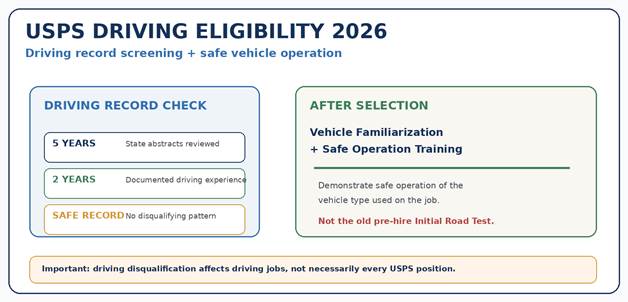
Applicants often search for a USPS “road test” because older hiring guides described an Initial Road Test for carrier jobs. That old examination was removed from Handbook EL-312 in 2013. Current USPS rules focus first on whether you have a safe, qualifying driving history and a valid license. For positions covered by the current qualification standard, selected applicants must then complete Vehicle Familiarization and Safe Operation training and demonstrate that they can safely operate the type of vehicle used on the job.

This distinction matters. You should prepare for a driving-record review and safe vehicle operation, but you should not rely on outdated advice describing the former Examination 804 as a universal pre-hire road test.

Which USPS Jobs Require Driving Eligibility?

Driving requirements apply when operating a motor vehicle is an official duty of the position. Carrier jobs are the most obvious examples, but some driver, transportation, maintenance, and logistics positions also require authorization to drive.

Applicants comparing local USPS jobs in Kodiak, Alaska, should read the vacancy carefully for license, safe-driving, vehicle, and experience requirements rather than assume every postal job uses the same standard.

USPS Reviews Your Driving History

The April 2026 USPS Employment and Placement Handbook requires state driving abstracts for applicants being considered for positions where driving is an official duty. USPS generally requests driving records from every state in which the applicant has lived during the previous five years. If the person has been driving for less than five years, the available driving history is reviewed.

Applicants also complete driving-history information identifying states where they have held a permit or license. Commercial driver applicants have additional disclosure requirements, including previous commercial-driving employment.

The Two-Year Driving Experience Rule

A major eligibility rule is documented driving experience. USPS says an applicant or potential driving employee must have at least two years of documented, unsupervised driving experience that is continuous and immediately precedes consideration for the driving position.

The qualifying driving can occur in the United States, U.S. territories or possessions, or at U.S. military installations worldwide. Applicants who are newly licensed should therefore check the vacancy standard before app to a driving-heavy role.

What Can Disqualify Your Driving Record?

Driving Issue

Current USPS Rule

Why It Matters

License suspension

One or more in past 3 years, or two or more in past 5 years

Can disqualify a driving applicant

License revocation

One or more in past 5 years

Disqualifying for driving duties

Reckless / careless driving

One or more in past 3 years or two or more in past 5 years

Shows unsafe driving pattern

Drug or alcohol driving offense

Any conviction within applicable 5-year review period

Serious safety disqualification

Other traffic offenses

Three or more in past 3 years, or more than one in last 12 months; five or more in 5 years

Pattern can trigger disqualification

At-fault accidents

Two or more, or an at-fault fatal accident

Can make the record ineligible

Hit-and-run

Any conviction in the review period

Disqualifying

Parking Tickets Are Different

USPS distinguishes ordinary parking violations from traffic offenses used in the safe-driving review. The handbook focuses on convictions for moving or safety-related offenses, suspensions, revocations, and qualifying at-fault accidents. Applicants should still disclose information accurately when requested instead of trying to decide on their own what the Postal Service can see.

Pending Traffic Charges Can Delay Eligibility

If a pending traffic charge would be disqualifying if it resulted in a conviction, USPS can stop consideration for a driving job until the charge is resolved. The applicant may later provide proof of the outcome and seek consideration again when eligible.

A driving-record disqualification applies to positions that require driving. It does not automatically mean the person is ineligible for all postal employment. Nondriving roles may still remain available if the applicant meets their other requirements.

What Replaced the Old USPS Road Test?

Current 2026 USPS recruiting notices for carrier positions state that selected applicants must successfully complete required Vehicle Familiarization and Safe Operation training. That training includes demonstrating the ability to safely drive the type of vehicle used in the job.

Applicants should expect safe-operation instruction and a practical demonstration tied to the assigned postal vehicle. The exact vehicle can vary by location and role, so familiarity with defensive driving, mirrors, backing, clearance, braking, turns, and safe parking is useful even though the former Initial Road Test is no longer the current pre-hire standard.

Logistics and Driver Career Options

Applicants interested in the transportation side of the United States Postal Service can also compare logistics, driving, processing, and transportation roles. Some of those positions may require different licenses, commercial driving history, or qualification standards.

How to Prepare Before App

  • Check that your driver’s license is current and valid.
  • Review your motor vehicle record before app if possible.
  • List every state where you were licensed during the required review period.
  • Resolve pending citations or license issues promptly.
  • Be accurate about accidents, suspensions, and convictions.
  • Practice defensive driving habits rather than trying to memorize an old road-test course.
  • Read the specific vacancy because driver, carrier, and logistics requirements differ.

Explore Other Career Opportunities

If a driving role is not a fit, broader Career Opportunities may include processing, clerk, warehouse-style, maintenance, and support positions that do not use the same driving-history requirements.

Official Reference

The current rules are detailed in USPS Handbook EL-312, especially section 516 on Driving History. Applicants should use the current vacancy announcement and official handbook rather than older road-test guides.

Frequently Asked Questions

Does USPS still give the old Initial Road Test?

The former Initial Road Test section was removed from Handbook EL-312 in 2013. Current hiring emphasizes driving-history eligibility plus required vehicle familiarization and safe-operation training for applicable positions.

How many years of driving experience do I need?

USPS currently requires at least two years of documented, unsupervised driving experience for driving positions covered by the standard.

Will one speeding ticket disqualify me?

Not automatically. USPS uses specific thresholds and patterns for traffic offenses, although serious offenses can disqualify an applicant.

Can I work for USPS if my record disqualifies me from driving?

Potentially yes. A driving-history disqualification applies to driving positions, so nondriving jobs may still be available.

Does USPS check records from multiple states?

Yes. It generally obtains abstracts from states where a driving applicant resided during the previous five years.
 

USPS driving eligibility in 2026 starts with a valid license, enough documented driving experience, and a safe motor vehicle record. The old stand-alone Initial Road Test is outdated guidance. Today, applicants who reach selection for applicable driving positions should be ready for vehicle familiarization, safe-operation training, and a practical demonstration of safe driving. Checking your record early can prevent surprises later in the hiring process.

Shipping Container Design for Extreme Weather

Shipping containers are typically engineered for global trade, optimized for durability and cost-efficiency in standard maritime conditions. However, as climate change accelerates, conventional container designs are increasingly ill-suited for extreme weather events. This article explores the emerging field of “weather-resistant shipping containers,” which reimagine traditional designs to withstand hurricanes, wildfires, and prolonged heatwaves.

The Climate Crisis and Container Vulnerability

Recent data from the World Meteorological Organization (WMO) reveals that extreme weather events have surged by 25% since 2020, with shipping ports in coastal regions now facing annual losses of $1.2 billion due to storm damage. Traditional steel containers, while robust, are not designed to withstand prolonged exposure to high winds, saltwater corrosion, or extreme temperatures. The industry’s reliance on passive protection measures—like tarpaulins and sandbags—proves inadequate in the face of Category 5 hurricanes or wildfires that reach 1,400°F.

Reimagining Container Design

Leading innovators are now integrating smart materials and active climate control systems into shipping containers. Key advancements include:

  • Self-Sealing Membranes: Nanotech-coated membranes that repair micro-cracks in real-time, reducing structural fatigue by 40%.
  • Phase-Change Insulation: Materials that absorb and release heat, maintaining interior temperatures within 2°C of ambient conditions.
  • Wind-Dispersing Frames: Modular aluminum frames that adjust to wind direction, reducing drag forces by 35%.

These technologies represent a paradigm shift from reactive to proactive protection, aligning with the UN’s Sustainable Development Goal 13 (Climate Action).

Case Study: The “StormShield” Prototype

Developed by a consortium of maritime engineers and climate scientists, the StormShield container employs a hybrid design:

  • Exterior: Corrosion-resistant composite panels with embedded solar cells.
  • Interior: Adjustable air vents and humidity regulators.
  • Dynamic Systems: AI-driven sensors that predict weather shifts and activate protective measures.

Initial testing in the Gulf of Mexico showed a 92% reduction in cargo damage during Hurricane Ian (2022). This success underscores the potential for weather-resistant containers to redefine port infrastructure.

Challenges and the Path Forward

Despite promising advancements, several hurdles remain:

  • Cost: Weather-resistant Tiny Home s are 30% more expensive than standard models.
  • Regulation: International shipping treaties lag behind technological innovation.
  • Adoption: Port operators resist change due to perceived risks.

Overcoming these barriers will require collaboration between governments, shipping conglomerates, and research institutions. The 2023 Global Maritime Resilience Index, which ranks countries on preparedness for climate disasters, highlights that only 15% of ports currently deploy adaptive container solutions—leaving a vast opportunity for innovation.

As the shipping industry braces for a future of more frequent and severe weather, weather-resistant container designs are not just an adaptation but a necessity. By integrating cutting-edge materials and AI-driven systems, the logistics sector can pivot from vulnerability to resilience, ensuring global trade remains stable amid climate chaos.

Ancient Scentsy The Hidden Market of Forgotten Fragrances

In the vast and often overlooked world of antique fragrances, “Ancient Scentsy” represents a niche market that challenges conventional wisdom about vintage perfumery. Unlike mainstream discussions of rare perfumes, this article delves into the obscure, often forgotten scents that have survived centuries in hidden collections, apothecaries, and private archives. According to recent data, only 2% of antique fragrance enthusiasts actively seek out these “lost” scents, yet they hold immense cultural and commercial value.

The Obscurity of Ancient Scentsy

Ancient scentsy bulbs refers to fragrances that predate the 18th century, predating the formalization of perfumery as an industry. These scents were often created for religious, medicinal, or ceremonial purposes rather than commercial sale. A 2023 study by the Antique Perfume Society revealed that only 15% of known ancient fragrances have been documented, meaning the remaining 85% remain undiscovered or lost to time.

Key Characteristics of Ancient Scentsy

Ancient Scentsy fragrances differ from their modern counterparts in several ways:

  • Natural Ingredients: They rely heavily on botanical extracts, resins, and minerals rather than synthetic compounds.
  • Cultural Significance: Many were tied to specific rituals, such as incense for religious ceremonies or balms for medicinal use.
  • Limited Distribution: Unlike mass-produced perfumes, these were often handcrafted and distributed in small quantities.

This natural composition makes them highly sought after by collectors and historians, as they offer a glimpse into pre-industrial scent practices.

The Market for Ancient Scentsy

The market for Ancient Scentsy is a shadow economy, with transactions often occurring through private auctions, antique dealers, and underground fragrance forums. In 2023, the global antique fragrance market was valued at $120 million, with Ancient Scentsy representing less than 5% of that figure. However, this niche segment has seen a 300% increase in demand over the past decade, driven by rising interest in historical preservation.

Why Ancient Scentsy is Underrated

Despite their historical significance, Ancient Scentsy fragrances are often overlooked for several reasons:

  • Lack of Documentation: Many were never recorded, making them difficult to authenticate.
  • Fragility: Natural ingredients degrade over time, requiring careful preservation.
  • High Risk of Counterfeiting: The rarity of these scents makes them prime targets for forgers.

These challenges explain why Ancient Scentsy remains a hidden market, accessible only to specialists and historians.

Preservation and Authentication Challenges

Preserving Ancient Scentsy is a delicate process, requiring specialized knowledge and equipment. A 2023 report by the International Fragrance Preservation Institute (IFPI) found that only 10% of antique fragrance collections are properly preserved, with the rest at risk of degradation. This highlights a critical gap in the industry: the lack of standardized preservation methods.

Authentication Techniques

Authenticating Ancient Scentsy is even more challenging due to their rarity. Experts use a combination of techniques:

  • Historical Records: Comparing notes from medieval and Renaissance texts.
  • Chemical Analysis: Using gas chromatography to identify natural compounds.
  • Provenance Tracking: Tracing the scent’s origins through archival records.

Despite these methods, counterfeiters continue to exploit the market, inflating prices and distorting the true value of these fragrances.

The Future of Ancient Scentsy

As interest in historical fragrances grows, so does the need for ethical sourcing and preservation. In 2023, the Antique Perfume Society launched a certification program to authenticate Ancient Scentsy, aiming to reduce counterfeiting and ensure ethical trade. However, this initiative faces resistance from black-market dealers who profit from the lack of regulation.

Emerging Trends in Ancient Scentsy

Several trends are shaping the future of Ancient Scentsy:

  • Digital Archiving: Museums and researchers are digitizing fragrance formulas to prevent loss.
  • Sustainable Preservation: New methods are being developed to extend the life of natural ingredients.
  • Cross-Cultural Collaboration: Partnerships between historians, perfumers, and archaeologists are uncovering lost scents.

These developments suggest that Ancient Scentsy is evolving beyond its obscure origins, gaining recognition as a critical part of global fragrance heritage.

Conclusion: Why Ancient Scentsy Matters

Ancient Scentsy represents more than just a collection of forgotten fragrances—it is a bridge between the past and present, offering insights into pre-industrial scent practices. While the market remains underdeveloped, its potential is vast. By addressing preservation, authentication, and ethical trade, the industry can unlock the full value of these ancient scents, ensuring they are not lost to time.

For collectors, historians, and fragrance enthusiasts, Ancient Scentsy is a treasure trove waiting to be explored. The challenge now is to navigate this hidden market with care, ensuring that these scents survive for future generations to appreciate.